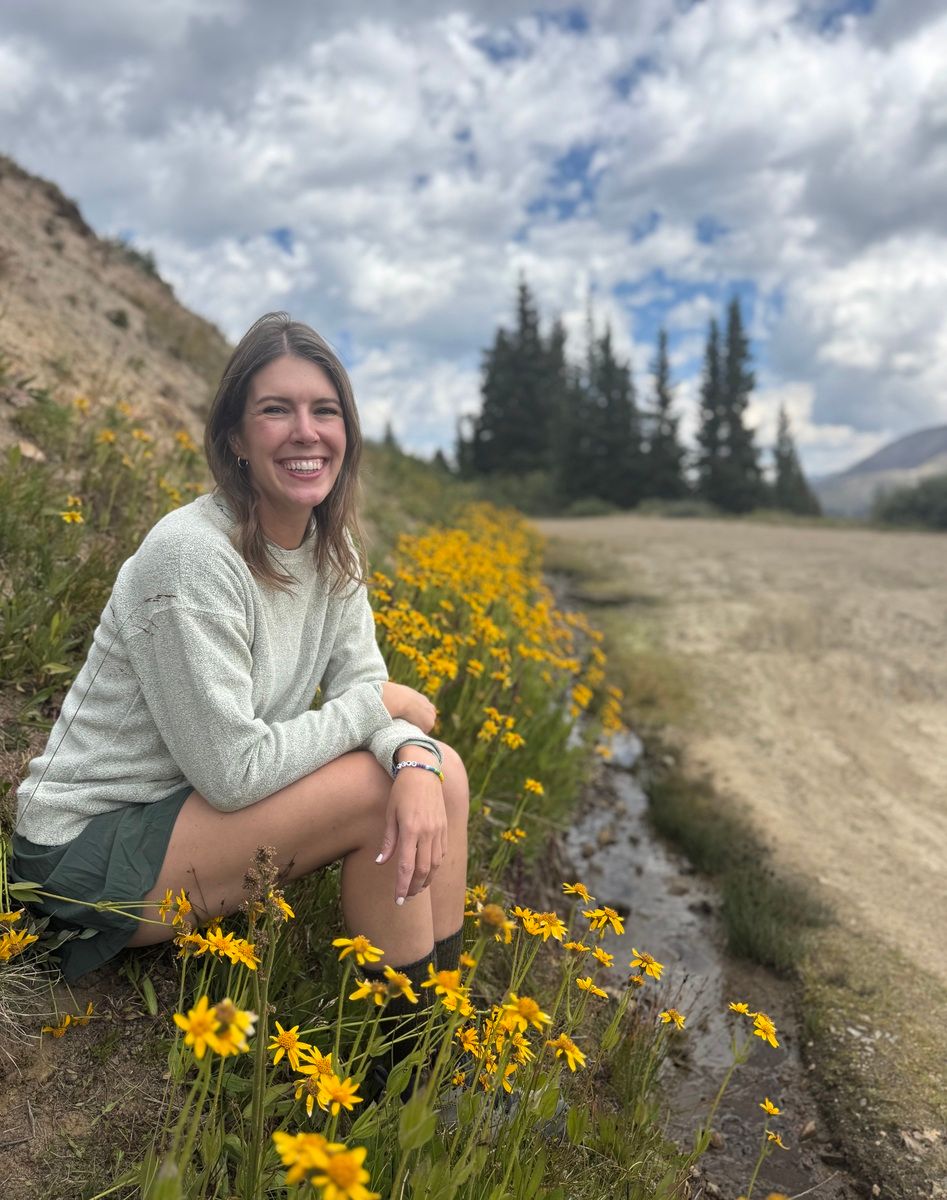

Welcome to this issue of Stumped by Nature, where we notice nature lurking just beyond our screens, curate a list of outside-y events in Austin, and build community with other folks in the thick of the startup ecosystem.
In this week’s issue:
☁️ Clouds
🌤️ Upcoming outdoors events
🥕 Local Farmers’ Markets
Let’s dig in!
-Nicole
PS. I know great people who haven’t met each other yet. Come meet them: join ATX Outsiders.
Upcoming events I’m hosting:
Saturday, September 12: Bat-Watching and Bat Q&A: Featuring THE Skip Hobbie
Sunday, September 27: Reverse Brain Rot: read/write/Barton Springs
Monday, September 28: Austin Reading Club: it’s even better than I expected it would be

August 31 Austin Reading Club

Not pictured: the camera shy books/articles
NATURE SPOTLIGHT
Years ago during a pocket of weekend that included dinking and athleisure, a therapist friend said at every red light, she intentionally looks at the clouds.
Not a quick dive to her phone for the notification stream.
Not the things happening under the underpass.
Not the bumper sticker rally on the car in front of her.
The sky.
Today we’re digging into clouds

August 2014, including a cloud of bats
The Lifecycle of a Cloud
Clouds are in the sky.
They’re made of water in liquid or ice form, cooled and condensed, clustering together instead of drifting like lost vapors.
There’s the whole water cycle, which includes evaporation aka sluicing from bodies of water, including puddles and pickleball players.
There’s thermal energy exciting the molecules so they rise.
An awareness of humidity.
Key words like dew point and transpiration, where plants use their roots like straws to slurp moisture from the earth, water vapor molecules seeping from their stomata.
But the transition from vapor to cloud form requires more than self-reliance. Microscopic floating dust/soil/smoke/sea salts are collaborators referred to as condensation nuclei, and they birth the collected, clumped globs of molecules that are clouds.
To make it rain, the merged cloud mass needs to grow big enough to outweigh the world around it and embrace the lure of gravity.

Science!
Name It, Notice It
Clouds are categorized by their base altitude and their physical shape. This is because Luke Howard, a pharmacist, spent a lot of time thinking about clouds in 1803, and knew that when you put language to something, you can understand the aspects of it and have common language to share observations. He declared three categories, gave them Latin names, and continued his career leaning hard into his meteorology interests.
The names he chose:
Cirrus: Latin for curl of hair. These are high clouds, thin and wispy, known as mare’s tails, like horses
Cumulus: Latin for heap. These are detached, fluffy, vertical clouds, with a flat base and rounded towers
Stratus: Latin for layer or something spread. These are broad, blanket-like
Bonus modification: Nimbus, meaning rain.
These names play well with others, for hybrids like cirro-stratus and cumulo-cirro-stratus and Nimbus 2000.

Clouds are constantly evolving, and since cloud observation is based on perspective, observers looking at the same cloud from different angles or elevation can report different cloud classifications. Sometimes we just need a Sisyphean task.
I was very tempted to keep digging around the National Oceanic and Atmospheric Administration website for the nuance of the basic ten cloud types, or the 27 cloud symbols.
But then I decided just staring out the window was a better use of my one wild and precious life.

Pretty solid window perspective
Local Cloud Behaviors
We have the joy of the Central Texas dryline—this is where moist Gulf air collides with dry desert air, and why we have explosive supercells.
Local lore includes the Invisible Austin Rain Dome, where storms chug in from the west and lose intensity as they cross the Balcones Escarpment, the 700 foot edge of the fault line under Mount Bonnell, where Edwards Plateau meets Blackland Prairie, then regain their hype on the eastern edge of the county.

The why is not unlike a sandbar in the ocean—here, the escarpment’s elevation change cuts the warm, moist air the storm needs for fuel, so the storm falls to pieces until it’s past the ridge. This rain dome phenomenon happens just often enough to make meteorologists leave people who expect to be very wet quite dry, but not often enough to have peer-reviewed certainty.
We also have Flash Flood Alley, where the combination of our terrain can whip up storms, but the shallow rocky soil can’t absorb heavy rain (toss in some over-farming and under-bisoning to intensify this), and the same geographic features that protects Austin from some storms is the catalyst for horror in others.
Cloud-Adjacent Curiosities
When I first queried “What is a cloud,” the top search results steered me toward The Cloud, “our global network of remote servers that store and process data for devices and computers.” Putting this in quotes because 1. I pulled it directly from the internet which 2. apparently that means I pulled it from the collective unconscious, embodied by physical hard drives in steadily humming, air conditioned rooms.

Cloud-seeding is a thing that’s been in practice in Central Texas since the 1990s. This is for actual in the sky clouds, with attempts to manipulate the weather. And now we have drones. The goal of cloud-seeding is to have a moderate increase of rainfall over a long period of time to boost farmers, utilities, and general water supply. The idea is to help the cloud with the cohesive agent that lets water vapor glob and hit the critical mass to precipitate. This is a regulated industry with public water notices, emerging data about its efficacy and downstream effects.

August 15, 2025, 10:56pm, NW Austin
Symbolic and Societal Clouds
A childhood favorite with big memories of pancake problems: Cloudy with a Chance of Meatballs
A stepping stone into childhood theology, where the closest Appalachian examples of Heaven/Hell were the clouds above and the coal mines below. Maybe it was especially good hell deterrent to have Centralia, Pennsylvania relatively nearby, with its 60+ year underground fire-induced mining ghost town
Side note: if you need to keep your hands busy while you dwell on your own childhood theology, perhaps this Cloud-draped Deity Diamond Painting kit will anchor that space

May 2014, 11am perspective from Rainey Street
In Meditation 101, the visualization of emotions as clouds drifting along, where the calm sky isn’t always visible, but we have certainty it’s there. How nice that when you put language to something, you can understand the aspects of it and have common language to share observations
Having your head in a cloud, which is quite different than brain fog
Pareidolia, the pattern-seeking behavior that includes looking for familiar shapes in shifting skyscapes
The various professions and hobbyists who have cloud literacy, including pilots, solar farmers, NASA, climate scientists, artists, and daydreamers
Turning into a puddle, which surely contributes to the water cycle


September 2, 2026, as captured by Sarah
I tried on my pickleball pal’s habit of looking up and out instead of phone-ward at red lights, and found myself surprised by how different the notoriously slow intersection on the way to school drop off looked at 7:30am than it did at afternoon pickup.
How different it feels to have a moment of wonder, to linger in awe, rather than to be stirred by firehose of scrolling dopamine.
UPCOMING EVENTS
🗓️ September 3: Offshore Austin: if you’re quick, you can catch a noon co-working yacht
🗓️ September 3: Knife Carving: get tactile
🗓️ September 3: Movies on the Lake: Legally Blonde: I object to staying inside
🗓️ September 5: Bat Fest: Lots of bats
🗓️ September 5: DIY Cyanotype Printing : this is sun-related and involves beautiful blues
🗓️ September 5: Birding & Nature Hike: the Master Naturalist leading this is socially obligated to answer your questions
🗓️ September 5: The Board Walks: always good for perspective
🗓️ September 5: September Star Party with Central Texas Astronomers: do your neck stretches before and after
🗓️ September 5: Arboretum Tour: two miles to soak up an arborist’s perspective
🗓️ September 5: Pioneer Ghost Tour: There is a 0% chance I’ll attend this, and I need to know more if you go
🗓️ September 6: Birding/Nature Walk at Hornsby Bend Bird Observatory: Meet Michelle at the Bird Shelter at 7:15am
🗓️ September 6: Watermelon Smash Bash: do it for the pigs
🗓️ September 6: Lagers and Literature: zine-making, a coffee cream ale, AND local authors and printmakers
🗓️ September 7: Laundry Day: instead of being domestic, learn about domesticity
🗓️ September 7: Astrophysics Lecture & Poetry Open Mic: on a several hundred person waitlist, but maybe it’ll work out for you
🗓️ September 8: Hill Climbers Tuesday Ride: hills are good for us
🗓️ September 8: Raptor Identification: learn your birds of prey
🗓️ September 9: Music On The Trail: Maybe what you need is mid-week live music
🗓️ September 9: Thought Experiments on Patios: straight to the deep talk
🗓️ September 10: Birds in the Landscape: a little glimpse into the broader ecosystem
🗓️ September 12: Bat-Watching and Bat Q&A: I’m co-hosting this. Bats!

LOCAL FARMERS’ MARKETS
Saturday
👩🌾 Arboretum Food & Artisan Market
👩🌾 Barton Creek Farmers Market
👩🌾 Lakeline Farmers Market
👩🌾 SFC Farmers' Market Downtown
👩🌾 SFC Farmers' Market Sunset Valley
👩🌾 Texas Farmers' Market at Bell
Sunday
👩🌾 Texas Farmers' Market at Mueller
That’s all for this week!
In the meantime, I hope your head is firmly in your desired cloud(s).
-Nicole
OPTIONAL SIDE QUESTS
🪵 Need to metabolize something? I help people write. Let’s chat.
🪵 Are you looking for a community of people in the startup ecosystem who go outside together? I’ve got you.
🪵 Speaking of, I chatted about local community building on this thing called a podcast
🪵 Are you sitting on a misogi-esque story? Spill.
🪵 Follow my calendar to know when we’re rallying.
🪵 I also write essays: this one is about witnessing a bison harvest.
🪵 Is this newsletter not your vibe? Forward it to your enemies to make them suffer too.
💰It’s safe to assume there are affiliate links, and I’ll monetarily benefit from any purchases you make. Hooray, capitalism! So far, this newsletter has generated $4.48 of cold hard cash. 💸